The Jackal: Poverty
Showing posts with label Poverty. Show all posts

23 Aug 2025

Curriculum Tweaks Won't Solve Learning Slump

New Zealand’s education system is in a slow-motion crisis, with student achievement sliding relentlessly. PISA 2022 results reveal a grim picture: mathematics scores plummeted to 479 (down 15 points from 2018), reading to 501 (down 4), and science to 504 (down 5), marking a 20-year decline equivalent to a year of lost schooling. The National-led government, in power since late 2023, points fingers at cell-phones, curriculum woes and truancy, but these are sideshows. The real culprit, child poverty, is being ignored, and National’s policies are once again making things worse.
 

On Tuesday, RNZ reported:

 
Education Minister Erica Stanford on raising writing achievement

Education Minister Eric Stanford is announcing the government's new Writing Action Plan to supercharge writing achievement and better set Kiwi kids up for success

The announcement comes the same day as a new study shows only a quarter of children at the end of intermediate school were writing and doing maths last year at the level expected by new curriculums introduced this year.

The Curriculum Insights study tested children in Years 3, 6 and 8 last year and results were released on Tuesday.

The study found children were doing about as well as in previous years.

But it found few were performing at the level expected by the incoming maths and English curriculums.

Just 22 percent of Year 3 children, 30 percent of Year 6 children and 23 percent of Year 8s were doing maths at the expected level.

And in writing 41 percent of Year 3s, 33 percent of Year 6 children and 24 percent of Year 8s were at the level expected of their age group.


Until poverty is tackled head-on, our kids will continue to struggle, no matter how many curriculum tweaks or attendance crackdowns we see. Poverty’s impact on learning is undeniable. Hungry children can’t focus; insecure housing breeds stress and illness. Research shows 14% of students skip meals weekly due to financial hardship, leading to score drops of 42–76 points across subjects, equivalent to 2–4 years of lost learning.

In 2024, child poverty metrics worsened: material hardship rose to 13.2% (152,000 children), up from 12.5% in 2022/23, with Māori and Pasifika children hit hardest. National’s austerity measures, slashing minimum wage growth and freezing welfare adjustments, have deepened this crisis.

Real-term cuts to benefits amid rising costs have left many families scrambling, with 20% of households with school-age kids unable to afford healthy food. The government’s policies, significantly skewed toward high earners, and cuts to school lunches, that have largely become inedible, offer no relief to struggling families, ensuring more children are hungry, unable to learn.

Poor housing is another anchor dragging down children's achievement. Overcrowded, damp homes, common across New Zealand, lead to health issues like respiratory problems, with hospitalisation rates for poor children 2–3 times higher than their peers. These conditions lead to students missing school, disrupt sleep and study, compounding stress and reducing focus. Limited access to resources, like internet or school supplies and uniforms, further isolate low-income students.

The current neoliberal government in New Zealand has also made housing for anyone who rents less secure, scaled back social housing investment and made it harder to attain emergency housing. This retreat from housing support entrenches instability, leaving many thousands of kids in environments hostile to learning.

National’s apparent indifference, prioritising landlord tax breaks over beneficial housing reforms or housing programmes, signals a disregard for the conditions that shape educational success. In particular, the National-led government's archaic policies appear to be largely targeted at Māori children, with a return to the bad old days of banning te reo Māori from school literature, even though it's a proven effective tool for learning.


Yesterday, The Guardian reported:

Why is the New Zealand government cutting Māori words from some school books?

A shake-up of New Zealand’s curriculum has resulted in Māori words being scrapped from a selection of books used to teach five-year-olds and a decision not to reprint a well-loved book for young readers because it contained too many Māori words.

The changes have sparked widespread criticism from academics, teachers and authors, who have called it “an assault” on Māori identity and the latest in the coalition government’s efforts to prioritise English over the Indigenous language – criticisms the education minister has strongly rejected.

...

Why have the changes sparked criticism?

Principles, academics and authors have criticised the decision, saying it undermines the place of the Indigenous language and children’s ability to learn both English and Māori.

“It’s not only harmful from a cultural identity perspective, but it also gives very little faith in our children that they can grasp these very few, simple words,” said Dr Awanui Te Huia, associate professor at Victoria University of Wellington’s Māori studies department, Te Kawa a Māui.


Curriculum reform and attendance policies, while not irrelevant, are secondary to the social conditions required to provide effective learning. The current curriculum’s lack of clarity in subjects like science and outdated literacy approaches do need fixing, and low attendance (only 58% of students attended school more than 90% of the time in 2024) is a concern. But National’s obsession with structured literacy mandates and penalising poor families with truancy fines entirely misses the point.

A child who’s hungry or sick won’t learn, no matter how rigorous the curriculum or how often they’re dragged to class by parents afraid of further financial penalties. These measures distract from the root issue: poverty inhibiting children's potential to learn.

The coalition of chaos’ policies betray a wilful blindness to what matters. Instead of investing in things that work, like school lunch programmes, proven to boost engagement and achievement, they’ve slashed funding for Ka Ora, Ka Ako by $107 million annually, reducing per-student lunch budgets from $6.99–$8.90 to as low as $3, compromising meal quality for over 244,000 students in 2025.

Instead of expanding health services or social housing, they’ve cut social housing investment and restricted access to numerous social services, while funnelling $153 million to charter schools with no proven benefit. This isn’t just neglect; it’s a deliberate choice to let inequality fester while wasting taxpayer money on pet projects already proven to be failures.

In 2024, Stuff reported:

Charter school agency staff paid average salary of $158,889

The new charter school agency is paying its staff an average salary of $158,889 - much higher than Ministry of Education staff and more than 50% higher than the public service average salary.

The agency has 18 staff members and sits within the Ministry of Education. But it pays more than staff there, where the average salary is $112,300, according to the public service commission. Charter school agency staff are also paid 56% more than the average public service salary, which is $101,700. 


In April, Stuff reported:

Charter schools: David Seymour defends $10 million for 215 students

David Seymour is defending the $10 million budget for charter schools when seven have been operating since February this year with only 215 students enrolled in them.

By averaging the cost across the 215 students, it equates to roughly $46,500 per student and is significantly higher than the core funding per student at a state school, which is just above $9000.


The evidence is clear: poverty drives educational decline, and the coalition of chaos' austerity policies are only making the situation worse. If we want kids to thrive, we need a government that ensures they’re fed, housed, and able to be healthy, not one that punishes them for their circumstances. Until then, no amount of classroom tinkering will close the gap.

4 Jun 2025

Majority of Voters Think Budget 2025 is Terrible

The latest Talbot Mills Research poll has dropped a bombshell on the National-led coalition’s Budget 2025, and it’s not pretty. According to the NZ Herald, only 22% of Kiwis think this budget is good for New Zealand, while 33% reckon it’s outright bad. On a personal level, it’s even grimmer, only 9% believe it’ll benefit them, with 34% saying it’ll make things worse. 

David Talbot, the poll’s director, didn’t mince words: this is the worst budget reception in nearly 30 years of tracking. For a government that campaigned on economic competence, this is a slap in the face from voters who are clearly unimpressed with Nicola Willis’ fiscal fanfare.


On Saturday, the NZ Herald reported:


Budget 2025 tests poorly with voters, according to Talbot Mills Research poll.

The Government’s recent Budget has tested poorly with voters, according to the results of a new Talbot Mills Research poll.

Asked whether they thought the Budget delivered on May 22 will be good for New Zealand overall, bad, or would not make much of a difference, 33% said it would be bad and just 22% thought it would be good.

“We’ve been measuring New Zealanders’ reception of government budgets for nearly 30 years. This is the worst we’ve ever recorded,” said David Talbot, director of Talbot Mills Research.

“Across all three dimensions: overall, economic, and personal, it was judged by Kiwis to be net negative, and in each case the worst since our tracking began in 1996.”

Participants were also asked whether they thought the Budget would be good for the New Zealand economy, bad or would not make much of a difference.

The results showed 30% believed it would be bad for the economy and 27% thought it would be good. In terms of whether they thought the Budget would be good for them personally, bad or make not much of a difference, 34% of respondents said it would be bad and just 9% thought it would be good.


Nicola Willis called Budget 2025 “responsible,” claiming it’s steering New Zealand toward recovery. The people polled, representing a majority of New Zealanders, say otherwise. With 30% of respondents saying it’s bad for the economy and only 27% seeing it as a positive, the coalition’s big plan, centred on tax breaks for businesses and slashing public spending, is nothing more than a corporate handout dressed up as progress. The $6.6 billion “Investment Boost” for businesses, allowing a 20% immediate tax deduction on new assets, might thrill the boardrooms, but it’s left ordinary Kiwis cold.

The gutting of KiwiSaver contributions, now halved to about $260 annually, is another kick in the teeth for workers trying to save for their future. Willis’ claim that this will somehow help first-home buyers is laughable when employers are expected to offset higher contributions with lower wage increases. So much for “making New Zealanders better off.”

The coalition’s obsession with austerity and tax cuts for the wealthy reeks of trickle-down economics, a tired playbook that’s failed time and again. Meanwhile, means-testing Best Start and projecting a measly $200 million surplus by 2029 (using their cherry-picked Obegalx measure) shows a government more interested in micro-management and balancing books than addressing the cost-of-living crisis hammering households.

The poll’s damning verdict reflects a public that’s not buying the spin. With 78% of Kiwis in other Talbot Mills polls saying economic conditions are “poor” or “not so good,” it’s clear the coalition’s priorities are misaligned with what the country requires.


This budget’s failure isn’t just a policy misstep; it’s a political disaster for Christopher Luxon’s government. The coalition’s rhetoric of “strong fiscal management” is crumbling under the weight of public discontent. Talbot Mills’ data suggests a deeper malaise, voters aren’t just skeptical; they’re angry. If Luxon and Willis think they can coast to 2026 on corporate tax breaks and road cone hotlines, they’re in for a rude awakening.

The left must seize this moment. Labour, the Greens, and Te Pāti Māori need to hammer home the coalition’s disconnect, offering a vision that puts people over profits. Budget 2025’s polling debacle is a clear signal: Kiwis want a government that fights for them, not one that leaves more Kiwi families further behind.

2 Jun 2025

Ruth Richardson Gets Damehood for Wrecking New Zealand

In a move that’s left many gobsmacked, Ruth Richardson, the architect of the infamous “Mother of All Budgets,” has been named a Dame Companion of the New Zealand Order of Merit in the 2025 King’s Birthday Honours. The Honours Unit, Cabinet and the King must have rocks in their heads.
 
This accolade, meant to celebrate service to Aotearoa, feels like a slap in the face to the countless New Zealanders who bore the brunt of her ruthless economic reforms. Far from deserving a Damehood, Richardson’s legacy is one of deepened inequality, shredded social safety nets, and a callous disregard for the vulnerable.

As Finance Minister from 1990 to 1993, Richardson championed the neoliberal blitz known as “Ruthanasia.” Her 1991 budget slashed welfare benefits, privatised state assets, and deregulated markets with a zeal that made even some of her National Party colleagues wince. The fallout was immediate and brutal. Child poverty rates skyrocketed, with a 1996 study showing that the proportion of children living below the poverty line doubled from 14% in 1982 to 29% by 1994, as a direct consequence of her austerity.
 
Unemployment surged to 11.1% in 1992, the highest since the Great Depression, as her policies gutted public sector jobs and left thousands struggling. Income inequality widened dramatically, with Richardson helping to ensure that New Zealand is one of the most unequal nations in the world to this very day.


Today, RNZ reported:


Two former finance ministers receive King's Birthday Honours

Former National MP Ruth Richardson. Photo: Supplied

Two former finance ministers have been appointed Companions of the New Zealand Order of Merit at this year's King's Birthday Honours.

Ruth Richardson and Steven Joyce, both former National MPs, have been honoured for their services as Members of Parliament.

Three other former MPs - Ian McKelvie, Anae Arthur Anae, and Dover Samuels - have also received Honours.

'Early and decisive course correction was imperative' - Richardson

Richardson was well aware that an interview about her King's Birthday Honour would include questions on her time as finance minister.

The economic reforms she oversaw - and the 1991 'Mother of All Budgets' - made significant changes to social welfare and public services, the effects of which are still felt by many.

Richardson started by saying in 1991 New Zealand was at huge risk, and was drowning in a sea of debt and perpetual forecast deficits.


It’s true. When Ruth Richardson became Finance Minister in 1990, New Zealand faced a fiscal crisis, with public debt at 48% of GDP and deficits projected to persist. The National Party’s earlier policies under Robert Muldoon (1975–1984), particularly the debt-fueled “Think Big” projects, increased debt from 5% to 40% of GDP, exacerbating the crisis. Inefficient state enterprises and Minister's high spending further strained finances, setting the stage for Richardson's decision to make the poor pay for her parties financial failures.


Richardson’s defenders, including herself, claim her 1991 'Mother of All Budgets' and Fiscal Responsibility Act 1994 set a global standard for fiscal prudence. But at what cost? Her policies prioritised trying to balance budgets over human welfare, forcing austerity that crippled health and education services. Hospital waiting lists ballooned, and schools struggled as funding dried up.
 
New Zealand's social fabric tore apart, homelessness spiked, and food banks became a grim fixture in communities. Her reforms didn’t just trim fat; they cut into the bone of a society already reeling from Roger Douglas’ earlier experiments. But what makes this all the worse is that she’s never acknowledged the harm she caused.

Impact on Health Services and Hospital Waiting Lists

The 1991 budget introduced user-pays requirements in hospitals, shifting costs to patients for services previously funded by the government. This was part of a broader restructuring that reduced public spending on health.

A 2015 review noted that Richardson’s reforms caused “severe financial strains on hospitals,” leading to operational challenges. Hospital waiting lists grew significantly in the early 1990s, with a 1993 study reporting a 20% increase in elective surgery wait times from 1990 to 1992, attributed to reduced funding and increased demand on under-resourced facilities.

By 1994, some hospitals reported waitlists exceeding 12 months for non-urgent procedures, a stark contrast to pre-1991 levels. The introduction of user charges also deterred low-income patients from seeking care, exacerbating health inequities, as documented in a 1996 Health Services Research report. These outcomes align with claims that austerity “crippled health services” and caused hospital waiting lists to balloon.

Impact on Education and School Funding

Education funding faced similar cuts, with schools required to adopt user-pays models, such as increased parental contributions for basic services. The budget reduced per-pupil funding by approximately 5% in real terms between 1991 and 1993, according to Ministry of Education data. Schools in low-income areas struggled most, as they relied heavily on government grants.

A 1994 report from the New Zealand Educational Institute highlighted that many schools deferred maintenance, cut staff, or reduced programs, leading to larger class sizes and reduced educational quality. These struggles support the claim that schools faced significant challenges as funding “dried up” under austerity.

Social Impact, Increased Homelessness, and Food Banks

The budget’s deep welfare cuts, unemployment benefits reduced by $14 weekly, sickness benefits by $27.04, and family benefits by $25–$27, severely impacted low-income households. A 2015 Treasury report noted that welfare-reliant households saw their income drop from 72% to 58% of the national average between 1990 and 1993. Child poverty doubled from 15% in 1990 to 29% in 1994, and income inequality rose, with the Gini coefficient increasing from 0.30 to 0.33 by 1996. These economic pressures tore at the “social fabric,” as communities faced increased hardship.

Homelessness surged as housing support was cut amid rising costs. A 2017 European Journal of Public Health study noted that austerity policies in the early 1990s, including New Zealand’s, increased homelessness risks by reducing subsidies and social services. By 1993, estimates suggested a 30% rise in visible homelessness in urban centers like Auckland, with no comprehensive national data due to under-reporting. Food banks, virtually non-existent before the 1980s, became entrenched, with the Salvation Army reporting a 50% increase in food parcel distribution between 1991 and 1994.
Awarding Ruth Richardson a Damehood whitewashes her terrible legacy. It’s a tone-deaf endorsement of policies that prioritised corporate interests over people, leaving a generation, those who survived, scarred for life. The honours system is meant to uplift those who’ve served the nation, not those who’ve divided it and made it poorer. Richardson’s recent support for the controversial Treaty Principles Bill, which again undermines Te Tiriti, only underscores her disconnect from New Zealand's shared values.

This isn’t about rewriting history…it’s about accountability. Honouring Richardson glorifies a chapter of financial pain and increased inequity for New Zealand. If we’re to celebrate true service, let’s recognise those who’ve rebuilt what her policies broke, not the architect of the wrecking ball. Shame on the honours committee for this misjudgment, and shame on Ruth Richardson for believing that she deserves this Damehood. All she really deserves is our scorn.

26 May 2025

Budget 2025: National Fails to Lift Children Out of Poverty

The National-led government’s Budget 2025 a glossy package of half-measures that does nothing to shift the dial on child poverty in Aotearoa. Despite their rhetoric about economic growth and "social investment," the reality is stark: this Budget fails to deliver for our most vulnerable children trapped in hardship. Worse, it doubles down on policies that have already deepened inequality, leaving thousands of kids to bear the brunt of National’s obsession with austerity and benefit sanctions.


Today, RNZ reported:

 
Budget 2025: None of year's child poverty targets met

Since 2018, the government has had to report on progress towards child poverty targets and whether the Budget will help to address child poverty rates.

The latest figures, for the year ending in June 2024, were released in February this year. The rates, which did not significantly change from the previous year, showed:

13.4 percent of children suffered from material hardship
12.7 percent lived in poor households before housing costs were taken into account
17.7 percent lived in poor households after housing costs were taken into account

None of the target rates for 2023/24 were met. This was "at least in part" because of the effect of inflation on the cost of living. the report said.

Treasury forecasts show the targets for 2026/27 and 2027/28 are also seriously in doubt, with poverty rates set to remain roughly at their current levels until at least 2029.


The Child Poverty Report 2025, mandated by the Public Finance Act, shows no significant progress toward the 2028 child poverty reduction targets. In fact the National-led coalition has largely undone all of Jacinda Ardern's work to reduce child poverty rates in New Zealand. Around 27% of kids still live in households where food runs out sometimes or often, and New Zealand ranks a shameful 32 out of 36 wealthy nations for child wellbeing. National’s response? Tinkering with Working for Families thresholds and Accommodation Supplement boundaries, woefully inadequate tweaks that won’t lift the 119,000 children still in material hardship out of poverty.

National’s track record tells a grim story. Their previous policies, like tax cuts skewed toward the wealthy and slashing public service funding, have squeezed low-income families, driving up food insecurity and housing stress. The reinstatement of punitive benefit sanctions in Budget 2025 is a cruel twist of the knife. These sanctions, targeting those on Jobseeker Support, punish parents for minor bureaucratic slip-ups, pulling income from households already struggling to afford basics like food and power.

The Salvation Army rightly notes that this approach undermines the government’s own Child and Youth Strategy, ignoring the evidence that sanctions do little to boost employment but plenty to deepen poverty. Kids don’t choose their parents’ circumstances, yet National’s policies ensure they pay the price.

Then there’s the neglect of our health system. Budget 2025 throws crumbs at health infrastructure but fails to address the crippling doctor shortage, particularly in general practice. Rural and low-income communities, where child poverty is most acute, are left scrambling for access to GPs. National’s also ignored calls to incentivise clinics to boost immunisation rates, despite a worrying drop to 77.3% for 8-month-olds in high-deprivation areas, down from 91.3%. This isn’t just a statistic, it’s a recipe for outbreaks of vaccine-preventable third-world diseases, condemning more kids to grow up unwell in a system that’s failing them.

National’s Budget 2025 is a betrayal of Aotearoa’s kids. Instead of bold investment to break the cycle of poverty, we get sanctions that entrench hardship and a health system left to limp along with barely enough to keep the lights on. Chief Children’s Commissioner Dr. Claire Achmad said it best: the government must make ending child poverty a national priority. Until National stops procrastinating and starts investing in families, health, and equity, our kids will continue to pay for their failures.

24 May 2025

NZ Child Suicide Crisis: Experts Muddying the Waters

Sarah Hetrick
The latest UNICEF Report Card 19 has delivered a wake up call to New Zealand’s conscience, ranking us dead last for child and youth mental health among 36 OECD and EU countries, with the highest youth suicide rate at 17.1 per 100,000 for 15 to 19-year-olds, nearly X3 the average for other high-income nations. But despite the well-researched UNICEF statistics, certain so-called “experts” are crying foul, claiming the numbers are “misleading.” Their arguments, rooted in technicalities about confirmed versus suspected suicides, not only undermine the gravity of the crisis but also distract from the government’s insidious tweaks to reporting that obscure the true scale of the tragedy.

On Friday, RNZ reported:

Misleading figures on New Zealand youth suicide rates

Two researchers from the University of Auckland, who are experts in youth mental health, say that figure is wrong.

The global charity's report on child wellbeing came out last Wednesday, with New Zealand ranking the lowest of 36 countries for mental wellbeing.

The graph attracting the most attention was the one on youth suicide rates, in which New Zealand outranked all other countries, with a rate of 17.1 per 100,000 15-to-19-year-olds.

"This is our whole world, this research, so we know what the data looks like for New Zealand," associate professor Sarah Hetrick told The Detail.

"We just knew when we saw it that it wasn't correct."

...

Associate professor Sarah Fortune, who is the director for population mental health at University of Auckland, explained the difference.

"The first one is called confirmed deaths, so that tells us that the circumstances of that person's death have been reviewed by the coroner and have been recorded as being a suicide death," she said. "Then we have suspected cases, which indicates that that situation is still open to the coroner."

The UNICEF Report Card 19 analysed trends in youth suicide using only data on confirmed suicide rates.


Hetrick and Fortune, both tied to the University of Auckland, argued that the UNICEF figures, based on confirmed suicides from 2018-2020, are outdated and inflated, pointing to more recent suspected suicide rates of 12.3 per 100,000 (2021-22) and 11.8 (2023-24). They lean on the fact that New Zealand’s coronial process distinguishes between “confirmed” and “suspected” suicides, suggesting the UNICEF data doesn’t reflect a downward trend in suspected cases.

But this is a sleight of hand. The UNICEF report uses globally comparable data to ensure fairness, drawing from confirmed suicides to align with other countries’ methodologies.


More troubling is the government’s role in this preventable tragedy. Knowing that things would likely continue to get worse, everyone but Labour voted in 2016 to make changes to suicide reporting protocols, which has restricted what qualifies as a “confirmed” suicide. The coronial process, already slow, now demands stricter evidence, delaying or outright excluding certain cases from official tallies. It’s also the reason why the latest suicide stats are showing a decline, while all the social conditions that cause suicide are continuing to worsen. This isn’t just bureaucratic red tape…it’s a deliberate move to suppress the numbers and make things look better than they actually are. By focusing on “confirmed” versus “suspected” suicides, and limiting reporting, the government creates a mirage of progress while the real crisis festers. The UNICEF report’s 17.1 rate isn’t an anomaly; it’s a snapshot of a systemic failure that’s actually worse than reported, given the new criteria reducing confirmed cases.

Sarah Fortune
The existing numbers already paint a very bleak picture. Māori and Pacific youth are disproportionately affected, with Māori suicide rates 1.7 times higher than non-Māori for males and 2.4 times for females. Poverty, racism, and a post-colonial legacy fuel this epidemic, yet Hetrick and Fortune’s focus on statistical nuances distracts from these structural drivers. The Youth2000 series, which they cite for broader well-being indicators, still shows 6.2% of youth attempting suicide, with higher rates in deprived areas. If anything, the data suggests the crisis is underreported, not overstated.

By downplaying the UNICEF report, these "experts" risk feeding a narrative that lets the government off the hook. The coalition of chaos’ austerity Budget 2025, with its 116 cuts that will disproportionately affect those already at risk, will likely worsen New Zealand’s terrible suicide rates. Instead of quibbling over numbers, we need to put pressure on the government to urgently invest in mental health services, housing stability, and poverty reduction measures. The real scandal isn’t UNICEF’s data…it’s the lives lost while people bicker about what set of statistics are correct, effectively providing cover for an administration that is only making an already atrocious situation worse.


Places to get help:

Lifeline (open 24/7) - 0800 543 354
Depression Helpline (open 24/7) - 0800 111 757
Healthline (open 24/7) - 0800 611 116
Samaritans (open 24/7) - 0800 726 666
Suicide Crisis Helpline (open 24/7) - 0508 828 865 (0508 TAUTOKO). This is a service for people who may be thinking about suicide, or those who are concerned about family or friends.
Youthline (open 24/7) - 0800 376 633. You can also text 234 for free between 8am and midnight, or email talk@youthline.co.nz
0800 WHATSUP children's helpline - phone 0800 9428 787 between 1pm and 10pm on weekdays and from 3pm to 10pm on weekends. Online chat is available from 7pm to 10pm every day at www.whatsup.co.nz.
Kidsline (open 24/7) - 0800 543 754. This service is for children aged 5 to 18. Those who ring between 4pm and 9pm on weekdays will speak to a Kidsline buddy. These are specially trained teenage telephone counsellors.
Your local Rural Support Trust - 0800 787 254 (0800 RURAL HELP)
Alcohol Drug Helpline (open 24/7) - 0800 787 797. You can also text 8691 for free.

9 May 2025

Huge Increase In Part Time Workers Earning Nothing

New Zealand’s part-time workers are caught in a vicious cycle, ground down by a system that punishes ambition and rewards poverty. Work and Income’s draconian deductions regime ensure that every extra dollar earned by part time workers is clawed back, leaving many with nothing to show for their efforts. Add sky-high rents and government handouts to landlords, and you’ve got a recipe for despair. The Coalition of Chaos isn’t only complicit in this fraud, they're actively rigging the game to keep wages low and welfare costs down, all while ramming through legislation that deepens inequality. This isn’t governance; it’s economic sabotage.

New Zealand Part Time Employment

Let’s break it down. Part-time workers, already scraping by, face immediate deductions from their benefits when they earn extra income. Accommodation Supplements, vital income for those crushed by New Zealand’s extortionate rental prices, get slashed as soon as you declare income from your part time work. For those with even higher costs, Temporary Additional Support also vanishes, leaving workers no better off than if they’d stayed at home on the couch.

A 2024 report from the Child Poverty Action Group highlights how these abatement rates create a “poverty trap,” where low-income earners lose up to 90 cents of every dollar earned through work. It’s not incentive; it’s punishment, especially when you consider that all work has overheads that 10 cents in the dollar aren’t going to cover.


In 2024, the Child Poverty Action Group reported:


ISSUES—THE CURRENT REALITY


Children whose families receive a benefit as their main source of income (around 200,000 children), are four times more likely than other children to live in poverty (material hardship).

Poverty due to low benefit incomes affects families of all ethnicities, but due to systemic issues such as racism and ongoing colonisation it inequitably affects whānau Māori, Pacific families and families of Middle Eastern, Latin American and African (MELAA) ethnicities.

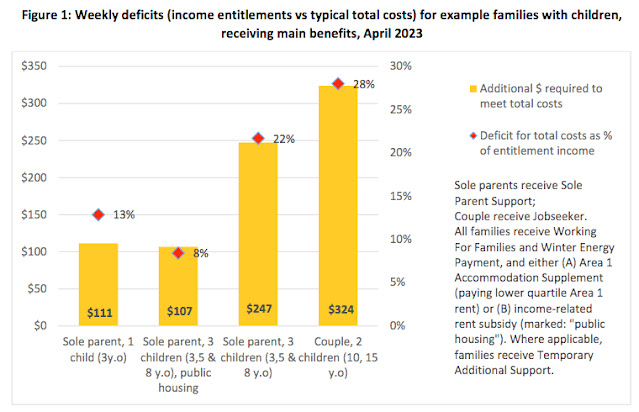
Benefit-recipient families with children usually do not receive sufficient income and entitlements to cover typical expected costs of living (see Figure 1below).

In public or social housing where rents are lower, a typical sole-parent family of three children is still receiving ~$107 less per week than they need to cover their typical costs.

Private rentals are much more costly; four-person model families paying market rent – one adult and three children, or two adults and two children – have deficits of hundreds of dollars a week: they receive around a quarter less income (~22% to~28%) than they need to cover typical costs.


CPAG 2023 Policy Brief on benefit adequacy

Three of the four example families in the figure above are not in public housing: their income entitlements are so low that the system locks the families into severe poverty, below the AHC40 poverty line (i.e.the families are receiving less than 40% of the after-housing-costs (AHC) median income equivalised for their family type).

Even though the entitlements for the example family living in public housing are higher, they are not high enough: this family is still locked below the AHC50 poverty line (ie the family is receiving less than 50% of the after-housing-costs (AHC) equivalised median income).

Income inadequacy is particularly profound for couples receiving benefits – not only for the examples above, but in general.


Supplementary payments

It is likely that the data and research presented in Figure 1 under-estimates costs because some rents are far greater, and disability costs (and inadequate entitlements) are not included. Real-life indicators show that bills are increasingly tough for benefit-recipient families: new benefit advances – MSD loans for approved basic-need purchases – rose to over $90 million in the quarter to March 2023 for the first time ever, and totalled $345 million in the year to March 2023.

These loans then further reduce the money families have to pay their bills: weekly debt repayments are not included in the costs above and for many families these repayments are high, due to the chronic inadequacy of income support over many years. Nearly 10% of New Zealanders owe money to the Ministry of Social Development.

Working for Families debt to IRD is also common and rising. On top of this, many families also carry private debt involving high costs and interest rates.

Hardship assistance

Hardship assistance to benefit recipients – including non-recoverable special needs grants as well as the benefit advances discussed above –has been increasing every year and topped $900 million in the year to March 2023 for the first time. Yet this assistance is another very conservative indicator of the depth of the inadequacy of benefit incomes. These grants and advances are at the discretion of Work and Income, meaning the process does not guarantee dignity, discouraging people from applying. Moreover,not all who ask for hardship assistance are successful, and they face a significant power imbalance if they wish to challenge that decision.

Abatement rates

It is difficult for many families who have the capacity for paid work to enter into paid employment. Abatement (clawback) of benefits starts early ($160, equivalent to seven hours minimum-wage work) and is steep (30c to 70c per dollar earned), meaning families cannot attempt paid work without losing financial security.


We all know that rents are a national disgrace, and the government is only worsening the cost of living crisis. Auckland’s median rent hit $660 a week in 2025, with other cities not far behind. The government’s response? Funnel billions into landlord tax breaks while renters drown in debt.

These subsidies prop up a parasitic property market, ensuring workers need Accommodation Supplements just to survive. But dare to earn a bit more, and Work and Income yanks that lifeline away. It’s a deliberate catch-22: stay poor on a benefit, or effectively work to retain 10% of your wages, which is arguably illegal under the Minimum Wage Act 1983.

The rise in part-time work is no accident. Stats NZ reported in 2025 that part-time employment grew by 4.2% year-on-year, while full-time jobs stagnated. Unemployment, hovering at 5.1%, is the highest in years, with Māori and Pacific workers hit hardest. The Coalition’s “traffic light” welfare sanctions, outlined in National’s policy, bully jobseekers into any work...often low-paid, casual jobs without any security. This isn’t about jobs; it’s about slashing welfare costs by forcing people into precarious employment. The government knows part-time workers are less likely to unionise or demand better wages, which is keeping the labour market cheap and compliant.

Then there’s the repeal of Pay Equity legislation. The Fair Pay Agreements, scrapped in December 2023, were designed to lift wages in female-dominated, low-paid sectors like care work. The Coalition’s decision to gut them ensures wages stay artificially low, entrenching gender and ethnic pay gaps. A 2024 Minter Ellison report noted that 13 pay equity settlements had been reached since 2020, but without legislative backing, progress has stalled.

Worse, the government rammed through the Employment Relations (Pay Deductions for Partial Strikes) Amendment Bill under urgency in December 2024, a move Labour’s Willie Jackson called a “cynical” attack on workers’ rights. This bill, which allows employers to dock pay during partial strikes, weakens collective bargaining and keeps part-time workers’ wages suppressed. The hypocrisy is galling, particularly because National previously supported pay equity but now champions policies that widen discrimination.

This government’s agenda is clear: manipulate the vulnerable into part-time work, trap them in poverty with benefit deductions, and prop up a landlord class while wages stagnate. It’s a well-designed system of cruelty, dressed up as economic reform. The Coalition of Chaos isn’t just failing part-time workers; it’s actively screwing them over. We need a system that rewards work, not one that punishes it...and for that to be a possibility we will need a change of government.

5 Jul 2021

Is Labour in denial about the housing crisis?

There’s no escaping the fact that New Zealand has the least affordable housing in the world. Not only are young Kiwi families being locked out of home ownership, because wages are low in comparison to our white hot housing market, but renters are also feeling the pinch as speculators increase rents to invest in even more properties and offset future costs.

It’s a dire scenario that’s resulting in not just housing unaffordability, but also increased homelessness, which will ensure New Zealand continues to rank as one of the most unequal countries in the world. The end result of course is a decrease in owner occupied buildings, which studies have shown is the bedrock of any functioning society.

So what’s the Government doing about it? Well not a hell of a lot if the numbers are anything to go by. Sure, Labour extended the bright-line test and made some changes to investor tax rules. They've also built around 8645 houses since June 2018. But this has had little to no effect on housing affordability and, it appears, a detrimental effect on the rental housing market.


On March 23, Stuff reported:


Rents hit new highs in the provinces as Covid-19 increases popularity of remote working

Rents surged to new highs in the provinces in February as more people turned to remote working since Covid-19.

The national median weekly rent increased 1.9 per cent to $530 from February last year, with gains in all regions, according to the latest Trade Me Rental Price Index. The biggest gains were in Manawatu/Whanganui, up 16 per cent, Hawke’s Bay, up 15 per cent, and Taranaki, up 13 per cent.


Meanwhile the accommodation supplement hasn’t increased at all.


A shortage of housing has pushed up house prices and increased demand for rental properties, which has pushed up prices in that market. Increases in rents have outstripped gains in income, prompting concern about what level of increase is reasonable, and spurred demand for rent controls.


It's pretty evident that realtors and speculators have by and large made good on their threat to evict tenants en masse because the Government implemented its healthy homes standards. The net result of course is an increase in homeless people right across New Zealand.


On Saturday, the NZ Herald reported:


Housing crisis: Whangārei pair living in park trespassed as homelessness skyrockets

Whangārei rough sleepers are facing trespass notices amid a rapid rise in homelessness.

This week, RNZ revealed new figures showing the city's homeless population had increased from 21 people in 2018 to 293 in 2020.

The figures were part of a Northland District Health Board report released this week.

It said "a very high proportion" of homeless were Māori and that was "reinforcing and extending existing inequities" but it was "unlikely there is sufficient transitional housing in Northland to meet the need".


It was obvious to everyone but the Government that if realtors and investors were given any leeway to squeeze more money out of housing, they would. An increase in homelessness likely wasn’t a concern to them at all. In fact this works in their favour because people who’re caught in the rental poverty trap are less likely to come forward about their substandard rentals or abusive landlords for fear of becoming homeless.

It’s a catch twenty-two situation being that the Government is relying on tenants to inform them about any failure to comply with the healthy homes standards as well, which basically renders the policy toothless! Obviously there needs to be inspectors to ensure compliance, because the industry simply won’t regulate itself to any degree that's required.

So not only are rental properties going to be left vacant or dilapidated, which will cause an increase in poverty related crime and ill-health, the Government also loses out because tenants are effectively investing more money into non-productive assets on behalf of their landlords. This is the exact opposite of what the Labour Party apparently intended before it came to power, and despite the facts piling up, they’re still only willing to tinker around the edges.


Last week, Stuff reported:


Investor tax rule changes: Government 'will take action' if rents spike, Grant Robertson says

The Government “will take action if necessary” should investors hike rents to offset the effect of tax rule changes.

Finance Minister Grant Robertson issued the warning after introducing interest deductibility rule changes on March 23, which take away investors’ ability to offset home loan interest costs against rental income.

Robertson would not comment on whether he would consider national or targetted rental increase caps if landlords did hike prices.

He said for the year to February 2021, Stats NZ recorded rental price increases of 3 percent.

“We will be monitoring the impact on the rental market closely and we will take action if necessary.

“Tenants can also go to the Tenancy Tribunal if they think their rent is too expensive and not in line with the market to request a rent reduction.


So we’re back to the Government expecting tenants to piss their landlords off and potentially end up on the street. I mean doesn’t Robertson know that all the real estate agencies now keep a database of personal information on renters, which is likely being used to penalise anybody who tries to stand up for their rights?


“It is also worth noting that the changes to interest deductibility rules for current landlords are being phased in over a four-year period so any substantial price increases would not be justifiable in any event.”


It might not be justified, but it is happening. Grant Robertson’s language here clearly shows that he’s in denial about what's occurring in the rental housing market. It’s not a question of “if landlords hike prices” because they already have and will continue to do so well above anything that is justifiable.

We saw a similar blasé approach from the Prime Minister when she claimed that the banks were just speculating about rents increasing substantially due to a backlash because of the changes to investor tax rules.

Jacinda Ardern might claim to be watching the numbers closely in terms of rents compared to wage growth, but it’s clear that her eye has gone off the ball. With rents increasing in some areas by a whopping 16 percent, while wage growth is at 2.6 percent, the only recourse the Government logically has is a cap on rental increases. The longer they delay, the worse things will get not just in terms of quality of life for tenants, but also in terms of homelessness and the housing crisis in general.

Labour can simply kiss any benefits from their poverty reduction policies goodbye if they don't get housing right.

The Government should go even further to implement an Empty House Levy to penalise those speculators who've made their tenants homeless instead of fixing their substandard properties. This would also likely reduce the some 200,000 empty houses that are gathering dust in New Zealand at the moment. Otherwise Labour risks the housing crisis becoming its Achilles heel at the next election, even though they’re slowly inching forward in the right direction.

5 Oct 2020

Maori better off with Labour

Jacinda Ardern - Labour Party leader
We’ve all heard the claims by the right wing that poverty and homelessness have increased under the Labour led Government. And yes! On face value a few statistics look to have worsened over the past three years. However it’s not until you dig a bit deeper into the data that the truth is revealed.

By way of an argument, WINZ hardship grants are often held up as evidence that struggling Kiwis are now in greater need. However, the only thing this really shows is that more beneficiaries are getting what they’re entitled to. Despite the title, the number of grants being provided isn’t a proper indicator of increased hardship for those on low incomes.

The same can be said about the increasing number of clients on the Housing New Zealand waiting list. What the right wing wilfully ignores is that when the National Party was last in power they removed half of those requiring affordable or emergency housing from the waiting list, saying they no longer met the revised criteria. This decision was largely reversed under the Coalition Government, which has of course led to an increase of people on the waiting list. The current increase merely better reflects the depth of need in New Zealand for state housing, a need that didn’t suddenly change in 2017 with the incoming Government.

The right wing also likes to endlessly criticise Kiwibuild as some sort of monumental failure. However what they intentionally ignore here is that the scheme has helped over 700 Kiwi families into new homes. Overall, the Coalition Government’s house building programmes have built more than 6,000 homes, with another 4,000 currently being construction.

These achievements are in stark contrast to the 40,000 Kiwis who became homeless while the National, Act and Maori Party’s were last in power. The main contributor to this social degradation was John Key deciding to sell 6,000 state houses (many under dubious circumstances), which clearly contributed to the worsening housing crisis and dramatically increased the difficulty for those seeking safe and affordable accommodation through official channels.

Then there’s the Coalition Government's child poverty reduction and wellbeing legislation to consider. This policy has helped to ensure that less New Zealand families and their children are or will be subjected to long-term impoverishment. Because of this kind of policy, we've seen an improvement to seven out of nine child poverty indicators during Labour’s first term in power.

Jacinda Ardern has also invested in healthy lunches for school children, increased paid parental leave and implemented and then doubled the winter energy payment during the COVID pandemic...just to mention a few more worthwhile left wing policies that have been achieved to date. Such socially beneficial initiatives will likely also help tackle New Zealand's stubborn and unacceptable material deprivation statistics in the not too distant future.

But wait, there's more. Healthy Homes Standards are also going to pay even more health and wellbeing dividends with Labour announcing an extra $39 million investment into the already successful scheme.


Yesterday, RNZ reported:


Labour targets rheumatic fever with new Healthy Homes pledge 

The Labour Party is promising to kit out more homes with insulation, heaters and bedding if re-elected, saying the prevalence of rheumatic fever in New Zealand is a "national shame".

The party has pledged to pump an extra $39 million over four years into the Healthy Homes initiative, which has been running since late 2013.

The scheme assesses homes in at-risk areas and co-ordinates support to make them warmer and drier.

The funding would expand the initiative from 11 DHBs to all 20. Labour would also roll out 40 more rental inspectors to ensure landlords are meeting required standards - at a cost of $16 million.


There is of course a lot more to be done, but a big difference between the two main political rivals is that Labour, unlike the National Party, will ensure that incomes for those living on the breadline will increase over the next term of their governance.

In the likely event of Labour's re-elected to the front benches, the incoming left wing government will also look into the high price of food and building materials, which was initially promised but not implemented by Winston Peters.

But what cannot be overstated is that the achievements of the Coalition Government has already caused long lasting improvements, particularly for Maori families, measurable progress which should in my opinion be allowed to continue indefinitely.

7 Jul 2020

National lacks credibility on housing

National MP Nicola Willis
Housing, which I would argue is a fundamental human right, has long been a problem in New Zealand. Not only do we have some of the most overpriced houses in the entire world, much of the housing stock is substandard and therefore affects not just people’s health and our standard of living, but also our productivity and subsequently the economy as well.

So what can be done about it? Well despite the National Party’s repeated claims, the Coalition Government has in fact been doing a lot to try and fix the housing crisis. Has it been enough? No! But we’re talking about a problem that has been decades in the making. For the right wing to argue that it should’ve been fixed in just one term of a Labour led Government is slightly absurd to say the least.

Through their own ineptitude, the National Party has little to no credibility on important issues like housing, and therefore are unable to effectively critique the current Government, which is a serious problem for political discourse at the moment. In fact much of the right wings criticism is for problems they ignored or largely created while in power, which makes their disapproval of the current administrations progress, albeit incremental, all a bit ridiculous!


Today, NZ Stuff reported:

National Party admits it sold too many state houses

National’s new housing spokesperson has admitted the party was wrong to sell and convert more state houses than it built when it was last in office.
Nicola Willis, who took the housing portfolio in a recent reshuffle, told RNZ the net reduction in state houses under the last National government showed that governments needed to continue increasing the number of state houses.
Willis said National sold or converted “a couple of thousand” state homes.
“I think what we can see from that is yes, the Government needs to build state houses,” she said.
Willis accepted there was net loss of state houses under National.

Now if only National would stop denying reality on all those other important issues as well.

Willis said National acknowledged government building was part of the solution to the housing crisis, but it had to be supplemented by things like reform of the Resource Management Act (RMA) and rental regulations, which were discouraging investment.

A large part of the problem is that many politicians view housing as a commodity and not as an essential service. It therefore doesn’t matter if the Resource Management Act gets repealed or if there’s a promise to build more state houses, because the crucial cause of housing being scarce and unaffordable will remain unless there is a fundamental change to how those in positions of power view their investments. That’s because the housing market isn’t governed by supply and demand, it’s currently governed by rich and powerful people’s greed.


There are 200,000 empty houses in New Zealand, many of them perfectly suited as places of residence. They sit vacant while various political factions endlessly argue about who has failed the most on housing. Invariably those assets will continue to gather dust while the often idle owner’s paper wealth increases. Unless a large chunk of those properties are reintroduced into the housing market, the problem of unaffordability, homelessness and a dilapidated rental stock will remain very strong handbrakes to any economic recovery post COVID-19.

The other problem is that the current Government, Banks and RBNZ have done everything they can to ensure the housing market remains over-inflated. A two-tier welfare system, mortgage holidays, business subsidies and an incredibly low OCR are all designed to stop the housing bubble from bursting. That’s because many politicians and public officials have investments that would be negatively affected if the market properly corrected itself. Nicola Willis for instance has pecuniary interests in at least four properties, meaning she, like most politicians, will never implement any policy that might decrease the excessive wealth tied up in property.

She said that National’s record on housing would have been better if it had been allowed to stay in power for longer, as many better, well-insulated houses were under construction when the party left government after the 2017 election.

This is just rubbish! There was no evidence that National was going to build anywhere near the number of state houses that New Zealand requires. In fact they spent most of their time in power denying there was a housing crisis at all.

The current government was also having difficulty defending its own record on housing. Its flagship KiwiBuild housing programme was meant to build thousands of homes a year, but to date, fewer than 400 have been completed.
It was so far behind that it would take more than 400 years to reach its ten-year goal of building 100,000 houses.
It had a far better record on state housing, adding thousands of houses to the stock, although this had not been enough to keep up with a skyrocketing housing wait list.
Willis said the latest figures were “an indictment on the Government”.

Unfortunately for political reporter Thomas Coughlan and the National Party's housing spokesperson, as of May 2020, 575 houses had been built and sold under the KiwiBuild scheme, with another 321 awaiting sale. By using out-dated figures, you’ve got to ask if Nicola Willis is suitable to be a Member of Parliament at all, let alone promoted into Todd Muller’s shadow cabinet? I mean where exactly is the merit in having a dishonest idiot at the table?

It’s one thing to finally admit that John Key oversaw a net reduction of state houses, but to then ignore that her own government used unfair criteria to remove thousands of people from the state housing waiting list is incredibly dishonest! There's no question that the current Government’s removal of those restrictions is why there’s a large increase in people on the list. To ignore this fact and claim a system that now better recognises the true depth of need in our communities is extremely deceitful, even by National Party standards.

You would have to be exceptionally biased to believe that the state housing mess that National created over nine long years could be fixed in just one term. But I guess delusion, plus a good amount of self-interest, is what still drives the National Party these days. It certainly appears to motivate Nicola Willis’ wilful ignorance of her own party’s woeful track record on housing.

19 Feb 2020

Mike Hosking contradicts Stats NZ


If you follow politics in New Zealand you've likely noticed that the right wing have been going on and on about the Coalition Government failing to reduce poverty. In fact they’ve been incessantly claiming, in the absence of any conclusive data, that poverty has been getting worse.

Yesterday, NewstalkZB reported:

Mike Hosking: Attacking 'the rich' won't help Labour's anti-poverty pledge 
The numbers simply don’t lie, and the government can’t have it both ways. They can’t argue how well we are doing economically, which we are not any longer, sadly, and then fail to explain why every social indicator they have has exploded. 
They promised to tackle child poverty - they haven’t. 

Unfortunately for the deluded Mike Hosking Statistics NZ also reported yesterday that the number of people living in poverty, along with numerous other social indicators, improved under the Coalition Government.

Four and a half hours before Hosking published his ignorant rant the Minister of Finance, Grant Robertson, reported:

Kiwis better off under Coalition Government 
Stats NZ reported today that average household disposable incomes after housing costs rose 4.9% in 2019. This was the highest rise in four years and came as Stats NZ said average housing costs were unchanged over the year, while wages rose. 
… 
Today’s data also showed: 
  • 46,000 people were lifted out of poverty in 2019 based on moving above the measure of 50% of disposable income after housing costs.
  • The median household disposable income after housing costs has risen 10% over the past two years. In 2017, this measure had fallen 1.8%.

The National Party used to claim that there wasn’t a way to measure the number of people living in poverty. John Key even said that it was easier to count rodents than kids in poverty. But as soon as the right wing lost the 2017 election they and their propagandist mates wouldn’t shut up about it.

Now they will do their best to ignore these statistics clearly showing that the Coalition Government is delivering on their promises. Things like increasing the minimum wage, less unemployment (particularly for Maori) and providing increased hardship assistance to unemployed people are just a few of the changes helping to reduce poverty in New Zealand. There is of course a lot more that can be done, but 46,000 Kiwis lifted out of poverty in just one year is a damn good start.

The audacity of the right wing however to blatantly lie about poverty increasing, when it has in fact reduced significantly, clearly shows that they’re untrustworthy. You simply cannot believe a single word they say, especially old fools like Mike bloody Hosking.

14 Jan 2020

National's negative campaigning

Anybody who looked into the Dirty Politics saga knows all too well that honesty is often in short supply within the National Party. You would think that after the exposure the John Key government received over their untruthful attack politics, the National Party would learn from its "mistakes" and leave such underhanded campaigns in the past where they belong. However that unfortunately doesn’t appear to be the case.

Simon Bridges - Current Leader of the National Party

The National Party, now under the feckless leadership of Simon Bridges, is using the same old dirty political tactics, along with assistance from a largely biased mainstream media, to manipulate voters into believing that the current Government isn’t doing its job properly.

National aren't providing any actual evidence though. Instead they're undertaking an entirely dishonest and unconstructive campaign in the lead up to the 2020 election, which basically confirms that National are, as their propagandists like to phrase it, haters and wreckers!

Here’s a recent negative and untruthful tweet authorised by Simon Bridges:


Astounding disinformation indeed. So let’s address these false allegations.

1. Strong Economy

New Zealand’s economic growth is stronger than expected and better than most other major economies around the world. Even on a per person basis, New Zealand is doing better now than National’s last year in Government.

2. Reduced Child Poverty

In order to help achieve a significant and sustained reduction in child poverty, the Labour led Government passed the Child Poverty Reduction Act in 2018. Despite this legislation there hasn’t been a discernible reduction in the child poverty rate yet. In fact the latest statistics show that before housing costs are deducted, the child poverty rate has increased by around 1 per cent. 
However the most recent statistics account for only 9 months of the current administrations governance. For National to be arguing that 9 months is a long enough period of time to significantly reduce child poverty is dishonest! In the absence of available data, they’re simply trying to convince voters that they care more about impoverished children than Labour does, which is clearly a false narrative.
For National to be criticising the Government over Child Poverty, after 9 years of their neglect and significant cuts to social services, is simply ridiculous!

3. Light Rail

We all know that the National Party absolutely failed to do anything about Auckland’s congestion woes. That hasn’t stopped them attacking the Government over Auckland’s light rail though, which is still in the development stage. Cabinet is due to consider the two different proposals in February this year. Clearly the Labour Party never promised to build Auckland's light rail in 2019.

4. 1800 More Police

Once again the promise was to provide 1800 more Police within three years, not the year of delivery. Despite this, in September 2019, the Government announced that 1685 new Police constables had already been deployed and a further 220 aspiring Police officers were also training. That means the Government will exceed the Labour Party’s election promise.

5. Free Doctor Visits

This is another false claim by the National Party. 
The Labour led Government made GP visits free for under 14-year-olds in 2018. Also, the Government ensured that an adult with a Community Services Card won’t pay more than $19 to see the GP and young people aged 14 to 17 years, who have a parent or caregiver with a CSC, will be charged no more than $13.

6. More ECE Services

In the Labour led Government’s first Budget they increased funding for 100% qualified ECE centres by $276 million over four years. The promise was to boost ECE quality and the Government is in fact delivering on that promise.

7. One Billion Trees

Labour never promised to plant a billion trees in 2019. This is just more dishonest politicking from the National Party. The One Billion Trees Programme developed by the current Government has made significant progress and is on track to planting a billion trees by 2028.

8. Capital Gains Tax

The Government has failed to implement a Capital Gains Tax, likely because NZ First MPs are overly invested in property. The issue here is that Labour didn't campaign in 2017 on implementing a CGT. What they said is they would set up a Tax Working Group and then make a decision afterwards.
But why the National Party, who won’t implement a CGT either, is attacking the Government over this is nonsensical. The National Party clearly has no plan, or intention, of implementing policy that would make housing more affordable in New Zealand.

9. Kiwibuild

Labour’s plan was to build 100,000 high quality, affordable homes over 10 years. They now plan on building as many houses as they can, saying the initial figure was too ambitious. 
By October 2019, 726 houses had been built under the Kiwibuild scheme. However the Labour led Government has built 2837 houses since June 2018 when you include their community and state housing builds. Another 3563 Government housing programme houses (not including market supplied houses) are currently under construction. 
Contrast that with National’s plan to scrap Kiwibuild and replace it with nothing. In fact the previous right wing Government sold thousands of state houses to their developer mates at below market rates, which directly led to a prolonged housing crisis. There is no question that such corruption increased the number of homeless people in New Zealand.

We might not be seeing the amount of progress we want, but at least it’s progress.

The alternative to the Labour led Government's incrementalism on major things like Child Poverty and the Housing Crisis is a continuation of John Key's self-serving ideology and negativity from the National Party, which is obviously disappointing from a public and political perspective.

National aren't proposing any actual policy changes that are anywhere near researched or robust enough to even consider voting for. Instead they seem to be entrenched on the sidelines busily throwing stones, that with the truth getting in the way, are landing well clear of the mark.

24 Jun 2017

National penalising Kiwi homebuyers

The National led government appears to not give a damn that the levels of home ownership in New Zealand are continuing to decline.

After much public and media concern about housing, the government through the Reserve Bank changed lending criteria in 2013. However this has simply penalised many Kiwi’s who’re trying to purchase their first home.

But if that wasn’t bad enough, the crackdown on lending to first home buyer’s in New Zealand has meant overseas buyers now have an advantage over Kiwi's… and because of Trump and mainland Chinese wanting to get their capital out of China, they’ve been snapping up our houses like nobodies business.

Today, The NZ Herald reported:

First-time house buyers worst hit as house sales fall by 30% 
"Investors who need a loan have been shut out of the market but cash investors have picked up their share of sales - not first-home buyers or movers," said QV spokeswoman Andrea Rush.

"Cash buyers purchasing property in New Zealand from overseas or new migrants moving with cash reserves often have the advantage over New Zealanders of higher foreign currency exchange and they are not impacted by the lending restrictions."

Rush said because the Government does not accurately measure the number of residential sales to foreign buyers or new migrants there was no way of knowing what share of sales were going to those offshore.

The topic is obviously an election issue, and rightly so. Younger New Zealander’s need to understand that if National continues to govern for the baby boomers and foreign interests alone, many of them will never be able to afford a house.

That’s not only bad for the many generations shut out of home ownership; it’s bad for society in general.

Nick Smith lied about combustible panels in NZ

The Grenfell Tower fire, which has caused many more deaths than the 79 currently confirmed, was thought to have started because of a faulty refrigerator. However the cause of the fire spreading so quickly has been identified as substandard combustible cladding, an insulation that has also been identified on some buildings in New Zealand.

Yesterday, Radio NZ reported:

Two Auckland high-rises found to have combustible cladding

The Auckland Council has found two high-rise buildings clad with combustible panels similar to those implicated in London's Grenfell Tower disaster.

The council has not said which buildings are affected, but says they are privately-owned and the material is being replaced with fire-proof cladding.

I very much doubt that the PE cladding that gives off cyanide gas when burnt is already being replaced on those buildings. But without the Auckland Council actually naming what buildings have used it, there’s no way to really tell.

Surely the inhabitants of those buildings have a right to know if they’re living in a potential fire hazard. Of course the Council's and current government won’t tell them, because they will want to protect rich people’s interests.

Despite this, Building and Construction Minister Nick Smith last week told Morning Report his officials were "reasonably confident" the combustible panels "have not been used in high-rise structures" in New Zealand.

Smith obviously made that false statement without first checking the facts. It's not the first time he's gone off half cocked and lied to the public about an important life threatening issue either.

The deluded Minister for Building and Housing and Minister for the Environment was obviously trying to cover for the dodgy architects, contractors and owners of the buildings where the dangerous cladding has been installed.

As usual the National party’s only concern is for the wealthy and not those who could be harmed by an inferior and dangerous product. But I guess that's just free-market capitalism for you.